Funding guide · Funding news
NIH multiyear funding: why paying grants upfront means fewer awards
NIH multiyear funding means paying for all years of a grant upfront from one year's budget. NIH leaned on it heavily in fiscal year 2025. The result was fewer new awards from a similar budget, and Congress has capped it at the 2025 level.
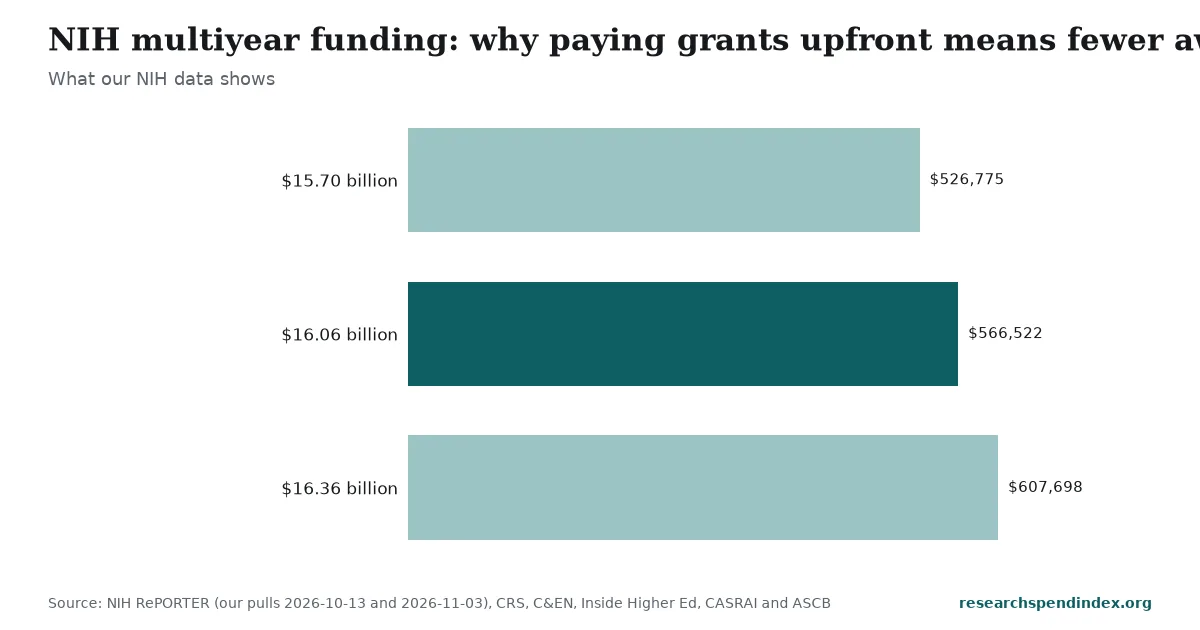
What our NIH data shows
We count R01 award records in NIH RePORTER for each fiscal year. The number of R01s fell two years in a row while the dollars rose, and the count of R01 records worth $2 million or more nearly tripled in 2025. That is the pattern upfront funding produces: bigger single payments, fewer of them.
| Fiscal year | R01 award records | R01 dollars | Median R01 | R01s of $2M or more |
|---|---|---|---|---|
| FY2024 | 29,417 | $15.70 billion | $526,775 | 138 |
| FY2025 | 26,804 | $16.06 billion | $566,522 | 415 |
| FY2026 | 25,660 | $16.36 billion | $607,698 | 383 |
Source: NIH RePORTER extramural awards, activity code R01, our pulls of 2026-10-13 (FY2024, FY2025) and 2026-11-03 (FY2026). Award records, not unique projects. RePORTER can still add late FY2026 records.
The short answer, in 30 seconds
Transcript: NIH multiyear funding means paying every year of a grant upfront, out of one year's budget. CRS says it likely contributed to fewer awards in 2025. In our data, R01 records fell from 29,417 to 26,804, while R01 dollars rose from 15.70 billion to 16.06 billion. Research project grant success rates dropped to 13% from 19%. Congress capped it at the 2025 level, in a law signed February 3, 2026. Research Spend Index.
What NIH changed, and the cost
In fiscal year 2025 NIH shifted more awards to a multiyear approach that funds the whole project period at the start (CRS report R48970). The Congressional Research Service says NIH made fewer awards in 2025 than its 2022 to 2024 average and that the policy likely contributed (CRS In Focus IF13131). C&EN reports 5,564 fewer grants than in 2024, an 8.6% drop (C&EN, March 2026). The same CRS note cites NIH data showing research project grant success rates of 13% in 2025, down from 19% in 2024, with similar total funding (CRS In Focus IF13131).
From 29,417 R01 records in 2024 to 26,804 in 2025 is 8.9% fewer in our data, while R01 dollars went from $15.70 billion to $16.06 billion.
The cap Congress wrote
The 2026 Labor-HHS appropriations, enacted in P.L. 119-75 and signed February 3, 2026, limit the NIH money that can be obligated for multiyear awards to the 2025 level (CRS report R48970). Inside Higher Ed described it as a ban on obligating more for multiyear grants than the year before (Inside Higher Ed, May 27, 2026).
For 2027, the Senate draft goes further in writing. CASRAI reports that Section 239 of the draft bill would cap 2027 obligations for more than one year of a multiyear award at the 2025 amount (CASRAI, November 17, 2026). The House committee bill also kept the multiyear limits from the 2026 law (AAMC Washington Highlights). ASCB notes that putting the limit in bill text, not only report language, makes it legally binding, and quotes the committee's concern that funding every year upfront "would significantly reduce the number of grants NIH is able to fund" (ASCB, November 20, 2026). NIH is operating under a continuing resolution through December 11, 2026 (NIH notice NOT-OD-26-131).
What it means for your next application
Paylines depend on how many awards an institute can make, so a cap on upfront funding should help new applicants more than it helps current grantees. Watch your institute's 2027 funding strategy once a full-year bill passes. Our NIH funding tracker shows this year's awards against the same date last year, and NIH budget 2027 covers the topline fight.
Questions
- What is NIH multiyear funding?
- It is NIH paying for several years of a grant at once, out of one year's budget, instead of funding it one year at a time. Each upfront award uses more of the current year's money, so NIH can make fewer new awards from the same budget.
- Did multiyear funding reduce the number of NIH grants?
- Yes, by most accounts. CRS says NIH made fewer awards in fiscal year 2025 and that the new multiyear policy likely contributed. C&EN reports 5,564 fewer grants than in 2024, an 8.6% drop, and research project grant success rates fell to 13% from 19%.
- Is there a limit on NIH multiyear funding?
- Yes. The 2026 appropriations law, signed February 3, 2026, caps the NIH money that can be obligated for multiyear awards at the 2025 level. The House committee kept the 2026 limits for 2027, and the Senate's draft 2027 bill would keep a cap at the 2025 amount in bill text.
- Does multiyear funding change my grant?
- If your award is funded upfront, you receive the full project period's money at the start rather than in yearly increments. There is no annual noncompeting renewal to wait on, but the institute has less room to fund new applications that year.